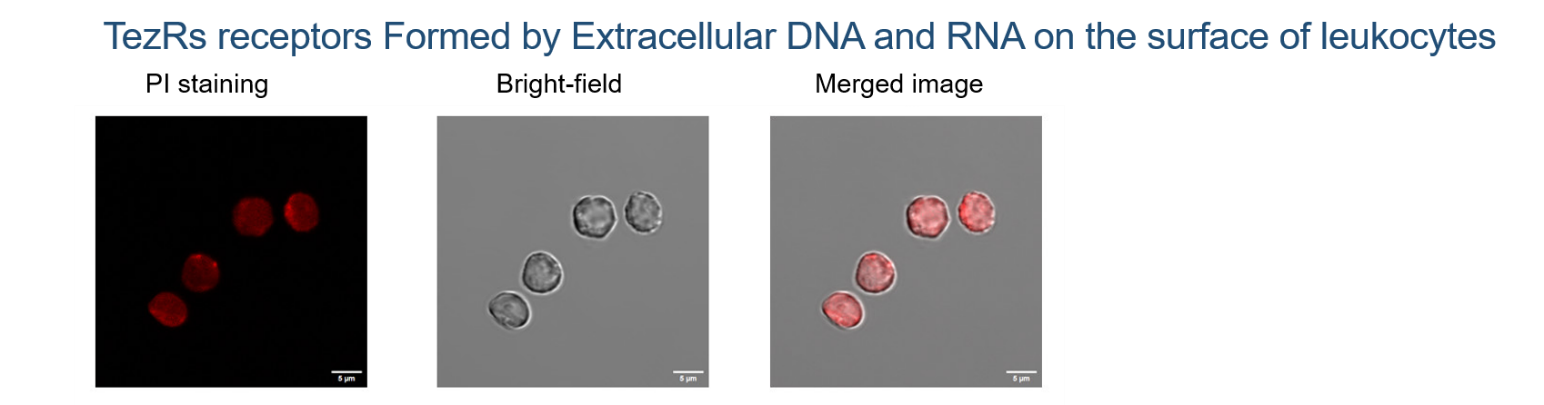
TezR receptors, or Teazeled receptors, are extracellular DNA- and RNA-based regulatory structures that form a key part of the Universal Receptive System.
Unlike traditional protein-based receptors, TezRs are composed of nucleic acids and function as a cellular interface with the environment. They help cells sense external conditions, process environmental signals, and adjust their behavior in response to stress, infection, immune activity, antibiotics, and other biological challenges.
TezRs have been described in both microorganisms and human cells. In bacteria, they regulate important survival mechanisms, including biofilm formation, antibiotic tolerance, resistance patterns, directional migration, and adaptation to hostile environments. This helps explain why microorganisms in real infections often behave differently from organisms tested under simplified laboratory conditions.
In human immune cells, TezRs play a role in regulating cellular activity and functional memory. By modulating TezRs outside the body, immune cells can be shifted into a more active therapeutic state without genetic engineering.
This principle is central to the development of Leukocyte-Tells and the SL-28 cell therapy platform, where donor immune cells are functionally reprogrammed through the Universal Receptive System to enhance their antimicrobial and anticancer activity.
TezR receptors represent a new class of cellular regulatory elements. Their discovery opens a new way to understand how cells sense their environment, store biological information, adapt to disease, and can be therapeutically reprogrammed.
Cell memory is the ability of a cell to retain information about previous exposures, conditions, or functional states and use that information to shape its future behavior.
Traditionally, cellular memory has been explained mainly through genetic and epigenetic mechanisms. Our work expands this concept by showing that cell memory is governed through the Universal Receptive System, including extracellular DNA- and RNA-based TezRs receptors.
References
- Tetz V, Tetz G. “Novel prokaryotic system employing previously unknown nucleic acids-based receptors.” Microbial Cell Factories. 2022;21:1–33. DOI: 10.1186/s12934-022-01923-0.
- Tetz V, Tetz G. “Novel Cell Receptor System of Eukaryotes Formed by Previously Unknown Nucleic Acid-Based Receptors.” DNA. 2022.
- Tetz G, Kardava K, Vecherkovskaya M, Khodadadi-Jamayran A, Tsirigos A, Tetz V. “Universal receptive system as a novel regulator of transcriptomic activity of Staphylococcus aureus.” Microbial Cell Factories. 2025;24:1. DOI: 10.1186/s12934-024-02637-1.
- Tetz V, Kardava K, Vecherkovskaya M, Khodadadi-Jamayran A, Tsirigos A, Tetz G. “Previously unknown regulatory role of extracellular RNA on bacterial directional migration.” bioRxiv / PubMed preprint record. 2024.
- Tetz V, Kardava K, Vecherkovskaya M, Khodadadi-Jamayran A, Tsirigos A, Tetz G. “Regulating white blood cell activity through the novel universal receptive system.” Scientific Reports. 2025.
- Tetz V, Kardava K, Vecherkovskaya M, Khodadadi-Jamayran A, Tsirigos A, Tetz G. “The Universal Receptive System acts as a novel regulator in the production of antimicrobial and anticancer bioactive compounds by white blood cells.” Journal of Leukocyte Biology. 2025.
- Tetz V, Kardava K, Vecherkovskaya M, Khodadadi-Jamayran A, Tsirigos A, Tetz G. “Dramatic Clinical Response to a Novel Form of Cell Therapy SL-28 in a Patient With Advanced Prostate Cancer: A Case Report.” ImmunoTargets and Therapy. 2025.
- “Partial response in a patient with skeletal and hepatic metastases following resected pancreatic cancer to the novel cell therapy SL-28: a case report.” Frontiers in Oncology. 2025.